
Technical Change Management procesing
APEX Change Management Consulting
Call for a Quote
+ 27 82 679 9307
Scroll Down
Our experience
Our experience is that the introduction of Level 9 on mechanised mines as new products and services is often not as successful as desired due to the key role players not being aligned before the initiation of a project or new service. Our expertise is in facilitating a bespoke process that aligns all key role players in the project or new services being introduced providing our clients with the maximin chance of successful Level 9 implementation. Doing all the work upfront to align role players to a successful outcome ensures that issues are identified and addressed before project implementation preventing delays, complications and cost overruns.
About Us

Praesent sapien massa, convallis a pellentesque nec, egestas non nisi. Praesent sapien massa, convallis a pellentesque nec, egestas non nisi. Vestibulum ac diam sit amet quam vehicula elementum sed sit amet dui. Curabitur aliquet quam id dui

Our Services

Collision Prevention System Technical Change Management Process
Our core service is based on ensuring our clients are completely satisfied with the outcome of a Level 9 Implementation. It is essential that all possible User Requirement technical risks are identified early and addressed in the Scope of Works for the effective implementation of the Level 9 project.
In facilitating this process, we provide a Change Management framework that outlines the process and provides for a regular progress feedback mechanism.
Due to many years of experience on mechanised mines and exposure to a number of Level 7, 8 and 9 implementation projects, we provide our client with informed guidance on items such as:
- Risk identification and mitigation.
- Preparation for CPS implementation
- Technology choices and selection
- Operational impact of Level 9
- Uninterrupted operational guidance

People Change Management
Why is change management necessary for implementing the chapter 8 legislation?
- Change is the only constant in the world and is considered to be the universal condition of humans. This applies to business organisations as well.
- Individuals and organisations must evolve and adapt to various challenges such as a change in technology, new competitors, new laws and regulations, and economic trends to survive.
- Nearly 50% of the organisational changes are unproductive due to improper implementation processes.
- There are certain steps that you need to follow to successfully implement a change management process.
- Managing the change process is one of the most valuable interventions for organisations to adopt in achieving their objectives.
- Without the users’ acceptance, uptake, and sustainable entrenchment CPS technology becomes nothing but a very costly “nuisance” factor which is what many current CPS system users experience.
Implementing the technology on its own does not solve a problem. The users’ acceptance, uptake and sustainable entrenchment is key to a successful implementation through an effective Change Management Strategy
Technical Change Management Process
- Technical Change Management objective is to align with client Level 9 expectations.
- To conduct a Technical Level 9 Gap analysis and assessment.
- To prepare an Operational Readiness Report.
- To provide the basis for the Final Scope of Works Agreement.
- To support the CPS implementation plan.
- To provide ongoing performance assessment.
- To provide a Technical Close Out of the Project



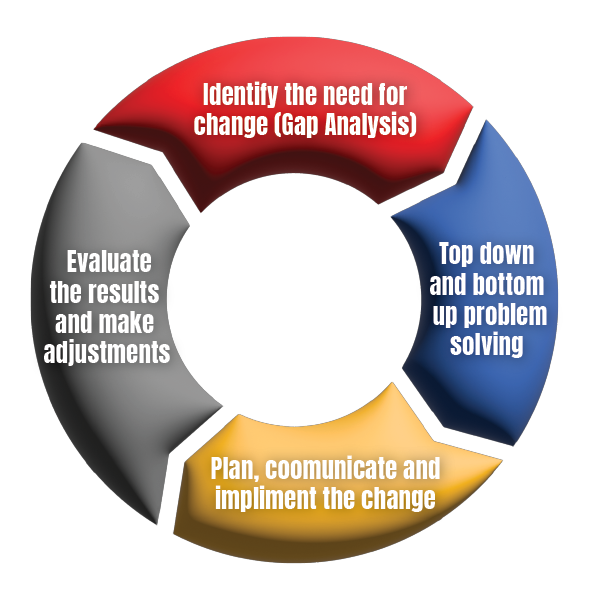
Management of change process:
- Clear Objective: align your change-related objective with the project goals
- Problem solving: Whether your team uses a top-down or bottom-up approach, provide purpose-built opportunities for collaboration between teams that don’t normally work together.
- Plan for the change: develop a realistic plan for implementing change
- Implement the change pan: change managers action the steps of the change plan
- Create a communication plan: Communication up and down the organisation has a profound effect on the entire process and makes it more transparent and digestible
- Identify and remove barriers: it is common to expect barriers to implementation, you need to deal with the issues promptly to overcome unforeseen problems.
- Understand key performance indicators: Use Key Performance Indicators(KPI’s) to track the change progress and any changes made to the process
- Evaluate the plan and adjust if necessary: If certain aspects fail to cater to your requirement or expectations, adjust the change process to fit into your requirement.
Common barriers to change:
- Change can often mean taking a chance with an increased risk of failure.
- Change can represent negative consequences for individuals or groups.
- Individual perceptions of change make it difficult to anticipate how they will respond.
- People often lack insight and understanding of situations causing the need for change.
- People are self-interested and fear anything which may have a negative impact on them.
- People usually resist change due to ignorance, fear and a lack of understanding.
- Change agents often fail to communicate the purpose and benefits of change.
How We Work
A typical example of what we do is with the introduction of the newly promulgated legislation around mechanised mining. South Africa’s Department of Mineral Resources and Energy (DMRE) has brought into law the Chapter 8 clauses of the Mine Health and Safety Act Regulations relating to Level 9 vehicle intervention for collision avoidance in trackless mobile machinery, both surface and underground.
Over 30 Years of Experience in Mining


Change Management
Lorem ipsum dolor sit amet, consectetur adipiscing elit. Donec sed finibus nisi, sed dictum eros.

Barriers to Change
Lorem ipsum dolor sit amet, consectetur adipiscing elit. Donec sed finibus nisi, sed dictum eros.
Contact Us
Contact
Pieter Wolfaardt
GCC Mines Works & Factories
Phone
+27 84 506 2020